
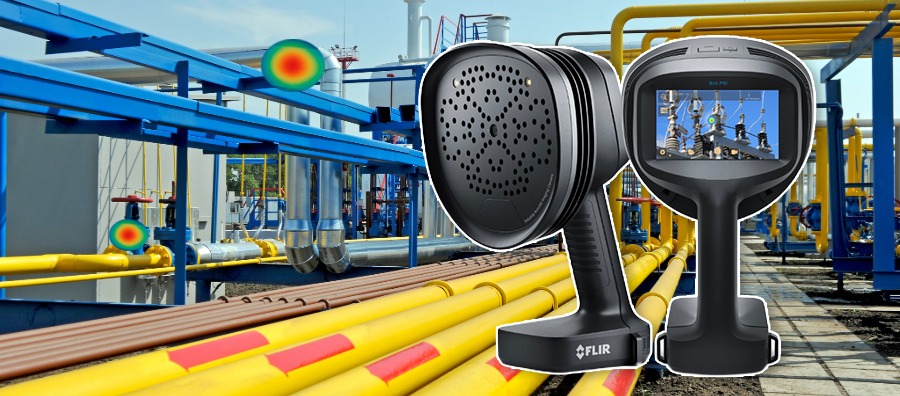
Gas leaks are still one of the most common yet underestimated safety risks in industrial sites and residential buildings. Regulations have improved, and gas detection equipment is widely used, yet in practice many leaks go undetected for long periods of time, and it is not usually because there is a lack of safety measures, but rather because of how traditional methods work.
Conventional gas detection systems often depend on gas accumulating at a sensor, being noticed by smell, or triggering an alarm once concentration levels rise. That approach assumes stable, enclosed conditions – something most real environments simply do not have.
In open, ventilated, or complicated spaces, those assumptions quickly fail. Small leaks can release gas slowly, disperse before reaching a sensor, and produce little to no odour or audible sound. If the gas itself is colourless and odourless, such as methane or hydrogen, the challenge becomes even more complex.
And this is where acoustic imaging technology comes into the picture. Instead of waiting for gas to travel, it detects the ultrasonic sound created at the leak source itself by turning that sound into a visual signal in real time, making gas leaks visible, faster to locate, and far easier to deal with.
The Hidden Risk of Undetected Gas Leaks
Undetected gas leaks pose serious risks that far exceed energy or minor losses. In industrial settings, leaking gases like methane, hydrogen, and CO₂ can create explosive conditions, thus increasing fire risk and putting people directly in harm’s way. Even when serious accidents are avoided, leaks that persist over time weaken equipment, speed up corrosion, and make unexpected mechanical failure far more likely.
The environmental and financial impact is just as serious. Methane, for instance, is a highly potent greenhouse gas that even small leaks can add up to significant emissions over time. From a business standpoint, leaking gas also has financial implications; if those leaks are not noticed, costs can rapidly go up through emergency repairs, unplanned downtime, regulatory action, and damage to reputation.
This is why early detection matters, because finding leaks early gives maintenance teams the chance to intercept and fix the problem before it worsens, thereby protecting people, equipment, and ongoing compliance with safety and environmental standards.
Why Traditional Gas Leak Detection Often Falls Short
Traditional gas detection still plays an important part in safety systems, but they have clear limits, especially in open environments or where the conditions are subject to regular change. More often than not, leaks are missed not because there is no detection in place, but because the technology used does not reflect how gas actually behaves in real operating conditions.
- Point Sensors and Fixed Gas Detectors
Point gas detectors measure gas concentration at a single, fixed location. This setup assumes that gas leakage will reach the sensor in enough concentrations to trigger an alarm. However, in outdoor environments or environments where there is enough air circulation, gas spreads quickly and may never reach the detector at all.
Airflow, temperature shifts, and physical layout of the plant and equipment further affect how gas travels, leaving large sections effectively unmonitored. While point sensors are useful, they can create a false sense of security if you rely on them as the only detection method.
- Odour-Based Detection
Odour-based detection relies on people noticing added odorants in gases, however this method is inherently unreliable. Sensitivity to smell varies from person to person, and the longer they are exposed, the more they are desensitised to the smell. Ventilation, outdoor conditions, and strong industrial odours can also mask smells completely.
For gases like hydrogen or CO₂, which are naturally odourless, this approach provides no protection at all.
- Ultrasonic Sensors Without Visual Context
Conventional ultrasonic gas detectors are able to detect the high-frequency sound produced by escaping pressurised gas, however, they typically only provide an alarm or a numerical value, with no indication of where the leak is coming from.
In busy industrial environments, this lack of visual context makes leak detection slow and uncertain, resulting in maintenance teams spending valuable time searching for the source rather than addressing the problem itself.
How Acoustic Imaging Technology Works
Acoustic imaging addresses these gaps by combining ultrasonic detection with real-time visual feedback. Instead of waiting for gas to build up, it detects the sound generated right at the source. Acoustic imaging works by:
- Capturing Ultrasonic Sound
When pressurised gas escapes through a crack, worn seal, or faulty valve, it produces ultrasonic noise beyond human hearing. Acoustic imaging cameras use arrays of highly sensitive microphones to pick up sound waves, even when the leak produces no audible sound and no detectable smell.
- Turning Sound into a Visual Map
The ultrasonic data is processed and overlaid onto a live camera feed. The result is a clear visual sound map that shows the exact origin of the leak. This allows operators to see the leaks as they happen, pinpoint their location with confidence, and prioritise repairs without stripping equipment or carrying out invasive inspections.
- Reliable Performance in Challenging Environments
Acoustic imaging thrives in conditions where traditional methods often fall short. Depending on the environment, leaks can be detected from several metres away, and in some cases, from distances approaching 100 metres, depending on leak rate and site conditions. Advanced filtering separates leak noise from background machinery and ambient sound, making the technology useful even in busy and noisy sites.
Explosion-proof acoustic cameras designed for hazardous Ex zones can be used during live operations. This reduces the need for shutdowns while improving safety and overall inspection efficiency.
Key Advantages of Acoustic Imaging for Gas Leak Detection
Acoustic imaging tackles the main shortcomings of traditional gas detection by finding leaks at the source, rather than waiting for gas to build up or relying on human senses. The key advantages include:
- Non-Intrusive, Remote Inspections
Inspections can be carried out from a safe distance, without having to enter confined or hazardous areas. This reduces exposure to dangerous gases and explosive atmospheres. It also means checks can be done while the plant is still operating, which helps avoid unnecessary downtime and keep maintenance costs in check.
Detecting Invisible and Odourless Gases
Because acoustic imaging detects sound and not gas concentration, it works regardless of the type of gas. Methane, hydrogen, CO₂, and other colourless or odourless gases can all be detected as long as they are escaping under pressure.
- Improved Safety, Compliance, and Environmental Performance
Finding leaks early significantly lowers the risk of fires, explosions, and equipment damage. It also makes meeting safety and environmental standards a lot easier. When organisations identify gas leaks sooner, they are able to cut greenhouse gas emissions and prevent potentially big expense.
- Continuous Monitoring and Automation
Acoustic imaging is not only limited to handheld inspections. Fixed installations and robotic systems can be used to monitor high-risk areas. This allows for 24/7 detection, early warning alerts, and integration with maintenance or safety systems, supporting a proactive and reliable approach to risk management.
Acoustic Imaging vs Traditional Gas Detection Methods
When we compare conventional gas detection technologies with acoustic imaging, the latter delivers clear practical advantages where it matters most on site.
Traditional gas detectors usually have a limited range and depend on gas physically reaching a sensor. This can delay detection or, in some cases, miss leaks altogether. Acoustic imaging, by contrast, can identify leaks from several metres away, and much further when leaks are larger or more intense, making a real difference when time is critical.
In terms of speed, acoustic imaging provides immediate visual confirmation of a leak, while point sensors and ultrasonic detectors without visualisation often require extra checks to understand what is actually happening. Accuracy is also higher, because acoustic cameras pinpoint the exact source of a leak rather than signalling a vague area.
From a safety and operational standpoint, acoustic imaging reduces the need for close-up inspections and unnecessary shutdowns. In many environments, it proves to be a safer and more efficient approach to industrial gas leak detection.
Where Acoustic Imaging Delivers the Most Value
Acoustic imaging is especially valuable in places where traditional gas detection falls short or where the cost of getting it wrong is high. Its ability to perform reliably in complex and hazardous industrial conditions makes it a powerful tool that is being adopted across multiple sectors.
In oil and gas facilities, for example, acoustic imaging is used to locate leaks around pipelines, valves, flanges, and compressors. This includes outdoor and offshore installations where gas spreads quickly. Chemical plants, on the other hand, benefit from fast, non-intrusive inspections in areas handling pressurised or hazardous gases, reducing exposure risks during routine and emergency checks.
As hydrogen infrastructure continues to expand in the UK, acoustic imaging plays an important role in detecting leaks from this highly volatile, odourless gas. In power generation, the technology allows inspections around turbines, boilers, and auxiliary systems without disturbing operations. Manufacturing and processing plants also use acoustic imaging to find leaks in compressed gas systems, improving efficiency and reducing avoidable energy losses.
The Future of Gas Leak Detection
Acoustic imaging is now a core part of inspection strategies focused on predictive maintenance and digital transformation. As part of Industry 4.0 initiatives, acoustic cameras can connect to data platforms, making it possible to track trends, spot early signs of failure, and plan maintenance more effectively. Fixed and automated systems allow for continuous monitoring, helping sites move away from reactive repairs and towards more proactive risk control.
At the same time, pressure to reduce emissions is increasing, both from regulators and from the public. In practice, this means organisations need detection methods that are fast, accurate, and non-intrusive. Acoustic imaging meets those expectations while also improving workplace safety, making it a practical and future-ready approach to gas leak detection.
Making the Invisible Visible
Gas leaks are often missed because they are silent, invisible, and dispersed before traditional systems can respond. Acoustic imaging changes this by converting ultrasonic sound into a clear visual signal.
By making the invisible gas visible, acoustic imaging improves safety, reduces downtime, and supports environmental compliance. For organisations looking to strengthen their gas leak detection strategy, it offers a precise, efficient, and long-term solution.
For assistance finding the right acoustic imaging camera for your needs, get in touch with our expert team today on 0113 248 9966, or contact us via email at sales@test-meter.co.uk.