
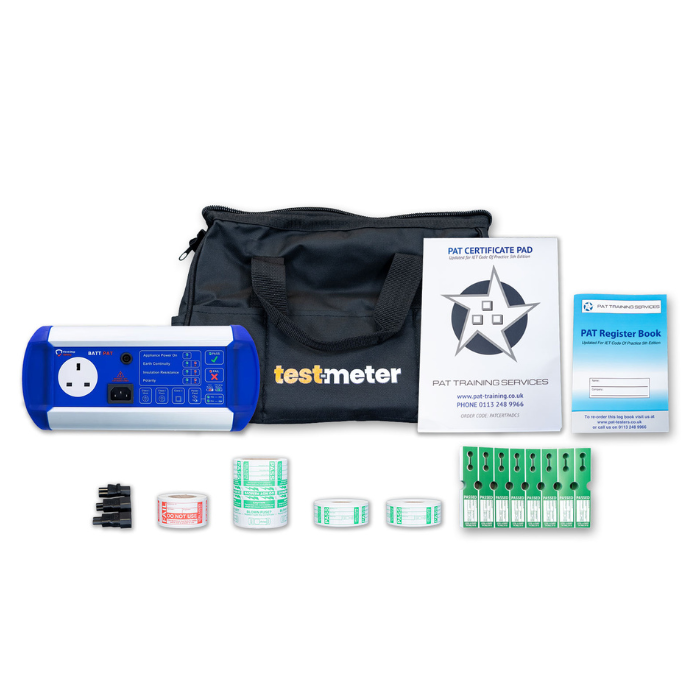
- BATTPAT Tester
- Test-Meter Kit Bag
- PAT Certificate Pad
- IEC Adaptor
- 2 x 500 PASS labels
- 250 PASS Wrap Labels
- 200 FAIL Labels
- 250 Tuff Tag Cable Wrap Labels
BATTPAT Contractors PAT Testing Kit

SKU: BATTPATCONKIT
Never Beaten On Price
We’re always working hard to give you the best possible price, but if you find it cheaper somewhere else, we’ll endeavour to match the price.
Call 0113 248 9966 or contact us online
Key Features
- Suitable for testing UK 230/240 V appliances and leads
- Long-lead testing capability for extension leads over 20 m
- Supplied with IEC adaptor for testing compatible IEC equipment and leads
Related Categories
£305.00
£366.00
We're always happy to offer help, information & advice to find the right instrument for you, so please get in touch.
To speak to our sales team, call us on 0113 248 9966, use our Live Chat service or contact us online.
Use reward points to get money off future purchases.
Please note: Customers must be signed into their account to be elegible. Find out more about reward points here.
We offer FREE standard delivery on all orders over £249, with a range of next-day options also available on many items.
Find out more on our delivery information page.
Key Features
- Suitable for testing UK 230/240 V appliances and leads
- Long-lead testing capability for extension leads over 20 m
- Supplied with IEC adaptor for testing compatible IEC equipment and leads
Related Categories
BATTPAT Contractors PAT Testing Kit
The BATTPAT Contractors PAT Testing Kit is designed to carry out electrical safety checks on UK 230/240 V appliances and leads. It is centred around the compact, battery-powered BATTPAT tester, whose portable design makes it easy to move between testing locations. Its straightforward PASS/FAIL operation allows users to quickly determine whether equipment meets the selected safety checks without navigating a complicated interface.
The BATTPAT is suitable for routine checks on Class I earthed and Class II double-insulated equipment, as well as extension leads and computer IEC leads. A single button initiates the required test, with separate LED indicators providing clear PASS or FAIL results for the insulation and earth bond checks. When testing extension leads and IEC leads, the tester can also perform a polarity check. Its long-lead function supports testing of extension leads over 20 metres in length, while compatibility with surge-protected extension leads adds further versatility for service and maintenance applications.
For contractors carrying out practical, lower-volume PAT testing, the BATTPAT focuses on the essential electrical safety checks rather than unnecessary complexity. The supplied IEC adaptor allows compatible IEC leads and equipment to be tested, while the PAT certificate pad provides a convenient way to record test results manually. Once testing is complete, the included PASS and FAIL labels can be applied to equipment to make its test status immediately visible. The Tuff Tag Cable Wrap Labels provide a durable solution for identifying cables and leads, helping markings remain clear during regular use.
Everything is supplied in a test-meter kit bag, giving contractors a convenient way to carry the BATTPAT tester, paperwork, adaptor and labelling supplies between jobs. The kit is particularly useful where equipment needs to be checked on site, during maintenance work or as part of routine workplace safety inspections.
While the BATTPAT provides fundamental electrical safety testing, visual inspection should also form part of a sensible PAT testing process. Checking appliances and leads for obvious damage, deterioration or other visible defects alongside the electrical tests helps provide a more complete assessment of equipment safety.
Key Features
- BATTPAT battery-powered portable PAT tester
- Suitable for UK 230/240 V appliances and leads
- Tests Class I earthed and Class II double-insulated equipment
- PASS/FAIL operation for quick and simple testing
- Clear LED indication for insulation and earth bond results
- Polarity testing for extension leads and IEC leads
- Long-lead testing capability for extension leads over 20 m
- Compatible with surge-protected extension leads
- Single-button test operation
- Supplied with IEC adaptor for testing compatible IEC equipment and leads
- PAT certificate pad for manual recording of results
- Includes PASS and FAIL equipment labels
- Tuff Tag Cable Wrap Labels for durable cable identification
- Supplied in a practical test-meter kit bag
- Ideal for contractors, maintenance personnel and workplace safety inspections
What's In The Box?
- BATTPAT Tester
- Test-Meter Kit Bag
- PAT Certificate Pad
- IEC Adaptor
- 2 x 500 PASS labels
- 250 PASS Wrap Labels
- 200 FAIL Labels
- 250 Tuff Tag Cable Wrap Labels
| No |
|

Please see our terms and conditions for full details of TM Care & Protect.

Everything you’re likely to require for the next 3 or 5 years:
✅ Annual calibrations included
No further calibration costs for either 3 or 5 years
✅ Free collection and return for annual calibration
No hidden postage costs when it’s time for calibration
✅ ‘Zero-Downtime’ for the life of your care plan
Free loan equipment should your purchase ever need sending away for repair
✅ Anti-theft protection
Each care plan includes a SmartTrace Forensic Marking kit that acts as a deterrent for your test equipment and other tools
✅ Instrument cleaning kit
Cleaning kit included with each TM Care & Protect plan
Our hope is that TM Care & Protect will bolster our commitment to support you throughout your journey with us, providing you peace of mind from the hassles of annual servicing, potential tool theft and loss of earnings.
Ensures complete reliability, minimised downtime and peace of mind. TM Care & Protect packages include:
✅ Annual Calibration
No further calibration costs for up to 5 years.
✅ Zero Unplanned Downtime
In case of any unforeseen repairs, we provide FREE loan instruments so you can continue working.
✅ Theft Deterrent Kit
Each care plan includes a SmartTrace forensic marking kit: The UK's most powerful theft deterrent. Use on your test equipment, van and tools.
✅ No Shipping Cost
Includes collection and return deliveries when it's time for calibration.
✅ Instrument Cleaning Kit
Avoid preventable issues by keeping your test equipment clean.
Our hope is that TM Care & Protect will bolster our commitment to support you throughout your journey with us, providing you peace of mind from the hassles of annual servicing, potential tool theft and loss of earnings.
Please see our terms and conditions for full details of TM Care & Protect.