
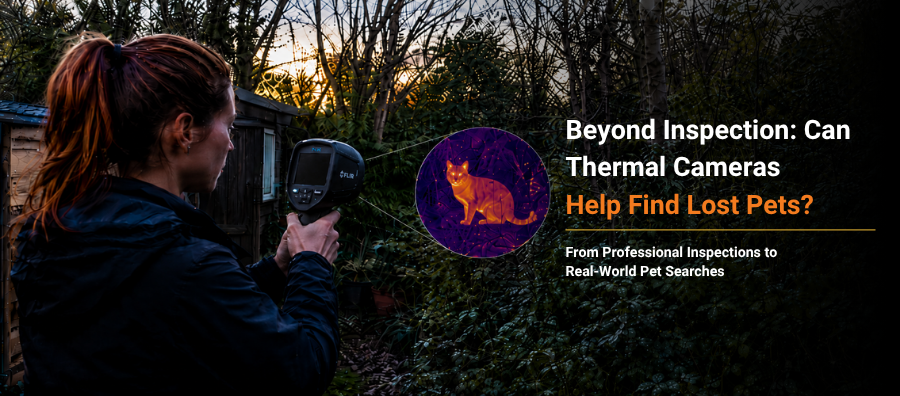
A missing pet can be an extremely stressful and upsetting experience, especially when every search of the garden, street or surrounding area seems to come up empty. Lost animals can be incredibly difficult to spot with the naked eye alone, whether it is a cat hiding silently nearby or a dog that has wandered into a field or woodland area. However, in recent years, the growing use of handheld thermal imaging cameras has given searchers another valuable way to detect hidden heat signatures that might otherwise have gone unnoticed.
This article looks at how handheld thermal imaging cameras can help support searches for lost pets, while also exploring how the same heat-detection technology is used across professional inspection, maintenance, building diagnostics, electrical testing and other specialist applications. It also explores how manufacturers such as FLIR have helped make thermal imaging technology more accessible for everyday inspection, maintenance and troubleshooting tasks.
Thermal imaging cameras work by detecting infrared energy, or heat, and turning it into a visible image on screen. Instead of relying on normal light like a standard camera, a thermal camera can highlight temperature differences between objects, surfaces and surroundings. This means that a warm animal may stand out more clearly against a cooler background, particularly in low light, complete darkness or colder outdoor conditions.
It is important to note that thermal imaging cameras cannot see through walls, doors or solid objects. Instead, they detect heat from surfaces and objects within view. When used carefully, however, they can help searchers identify heat signatures in areas that may be difficult to check visually, such as gardens, sheds, garages, fields, hedgerows and outbuildings.
Why Lost Pets Can Be So Difficult to Find
One of the main challenges in finding a lost pet is that animals do not always behave as expected when they are frightened, injured or disorientated. A cat that would normally come when called may be hiding silently close to home, while a dog may continue moving through fields, woodland or unfamiliar streets after becoming startled or disorientated. This can make even a careful visual search difficult, especially when there are sheds, garages, hedgerows or long grass nearby.
How Handheld Thermal Imaging Cameras Can Help
This is where handheld thermal imaging cameras can provide valuable support. By detecting heat rather than visible light, a thermal camera can help searchers identify warm areas that may not be obvious to the naked eye. In the right conditions, this can make it easier to spot a hidden animal in a garden, field, outbuilding, hedgerow or other difficult-to-check area.
Rather than being a direct replacement for a careful search, thermal imaging works as an additional tool. It can help users scan areas more thoroughly, particularly in low light, darkness or cooler conditions where an animal’s body heat may stand out more clearly against the surrounding environment.
This is the same core technology used in FLIR thermal imaging cameras, which are commonly used by electricians, engineers, building inspectors and maintenance professional to make temperature differences easier to identify. Although a missing-pet search is a more unusual example, it shows how versatile handheld thermal imaging can be when a user needs to detect heat that is not visible to the naked eye.
Real Examples of Thermal Imaging Success in Animal Searches
There are already real examples from across the UK where thermal imaging has helped locate animals in difficult conditions. In 2024, a missing cat named Stanley was found beneath floorboards in a house in Swindon, after a thermal imaging camera was used to search for his heat signature. The camera, which would usually be used for building and inspection work, helped reveal where he was hidden after he disappeared inside the property.
Thermal imaging has also supported animal rescue work in London. In North Harrow, the RSPCA and London Fire Brigade used thermal imaging cameras to help locate a cat and her kittens in a dark loft. The rescue showed how useful heat detection can be when animals are hidden in enclosed, poorly lit or difficult-to-access areas.
These examples show that thermal imaging is not limited to industrial or building inspection work. When used carefully, the same technology can support animal searches by helping users identify heat signatures in places that may be dark, enclosed or visually difficult to check. However, thermal imaging is most effective when the conditions are suitable and when it is used as part of a wider, careful search.
When Thermal Imaging Works Best
Handheld thermal imaging cameras tend to be most useful when there is a clear temperature difference between the animal and its surroundings. This often makes them especially useful in low light, at night, early in the morning or during cooler weather, when a warm body may stand out more clearly against the background.
They can also be helpful when checking areas such as gardens, fields, sheds, garages, barns, hedgerows and outbuildings. These are places where a frightened or injured pet may hide, and where a standard visual search may not be enough. By slowly scanning these areas with a thermal camera, searchers may be able to identify unusual heat patterns that deserve a closer look.
However, there are limitations. Warm weather, direct sunlight, heavy rain, dense vegetation and blocked lines of sight can all make thermal imaging less effective. A thermal camera also cannot confirm whether a heat signature belongs to a specific pet, so any suspected sighting should always be checked carefully and safely.
What to Do First if a Pet Goes Missing
While thermal imaging can be a valuable additional search tool, it should be used alongside the usual steps recommended when a pet goes missing. Pet owners should check the immediate area carefully, contact local vets and rescue centres, update their pet’s microchip details. For lost dogs, owners should also contact the local dog warden. It is also worth checking sheds, garages, gardens and outbuildings nearby, as frightened animals may hide quietly and avoid coming out even when called.
Local community groups, lost-pet websites and animal welfare organisations can also help spread the word quickly. Thermal imaging should be seen as one part of a wider search approach, helping to check difficult areas more thoroughly rather than replacing these important first steps.
A Versatile Tool for More Than One Application
While lost-pet searches show one unusual use of thermal imaging, the technology is far more commonly used in professional testing, inspection and maintenance work. By making heat patterns visible, thermal cameras can help users identify potential issues that may not be obvious during a standard visual inspection.
In electrical applications, they can help detect areas of unusual geat that may indicate overloaded circuits, loose connections or failing components. In building diagnostics, they can be used to investigate insulation gaps, heat loss, damp-related issued and underfloor heating performance. They are also widely used in mechanical maintenance, plumbing and heating checks, facilities management and general troubleshooting.
This versatility is what makes thermal imaging so valuable. Whether it is being used to support an animal search, inspect a property, check equipment or investigate a fault, the core benefit remains the same: it helps users see temperature differences that would otherwise be hidden.
FLIR Thermal Imaging Solutions at Test Meter
Although this article focuses on the use of thermal imaging cameras in lost-pet searches, the technology is most commonly used across professional inspection, testing and maintenance applications. Thermal cameras are widely used to identify heat patterns in electrical systems, building insulation, heating systems, mechanical equipment and other areas where temperature differences can reveal potential issues.
At Test Meter, we supply a wide range of thermal imaging cameras designed for professional and specialist use. This includes FLIR thermal imaging products, with options such as compact handheld thermal cameras, higher-resolution inspection cameras and thermal imaging IR thermometers available for different applications. These include handheld thermal cameras from leading manufacturers, with options available for building diagnostics, electrical inspection, maintenance, plumbing and heating work, and other test and measurement applications.
For example, compact FLIR thermal cameras such as the FLIR C5 are designed for quick inspection and troubleshooting tasks, while higher-specification models such as the FLIR E8-XT provide greater thermal detail for more demanding inspection work. FLIR thermal imaging IR thermometers, such as the TG165-X, also combine non-contact temperature measurement with thermal imaging to help users visualise potential issues more clearly.
The same heat-detection technology that can help locate a hidden animal is also used every day by engineers, electricians, surveyors, facilities teams and maintenance professionals. Whether users need a compact thermal camera for quick checks or a more advanced model for detailed inspection work, Test Meter offers a broad thermal imaging range to suit different requirements and budgets.
To find the right solution for your application, click here to view our full range of FLIR thermal imaging cameras.
This story uses the following sources:
· Chris Lockyer, ‘Missing moggy found with thermal imaging’ - https://www.bbc.co.uk/news/articles/cn445rzqdero, BBC News, last accessed 16 June 2026
· Chris Mitchell, ‘Five kittens and their mum rescued from loft in dramatic North Harrow rescue’ - https://harrowonline.org/2023/07/16/five-kittens-and-their-mum-rescued-from-loft-in-dramatic-north-harrow-rescue, Harrow Online, last accessed 16 June 2026

About the Author
Jack Forster holds a First Class BA (Hons) degree in Journalism and is Web Content Writer at Test Meter. His experience includes roles with FC Halifax Town and Bradford Bulls, he now channels his skills into combining technical expertise with creative storytelling. Outside of work, Jack enjoys live music events and is a passionate fan of his local football and rugby league sides.