
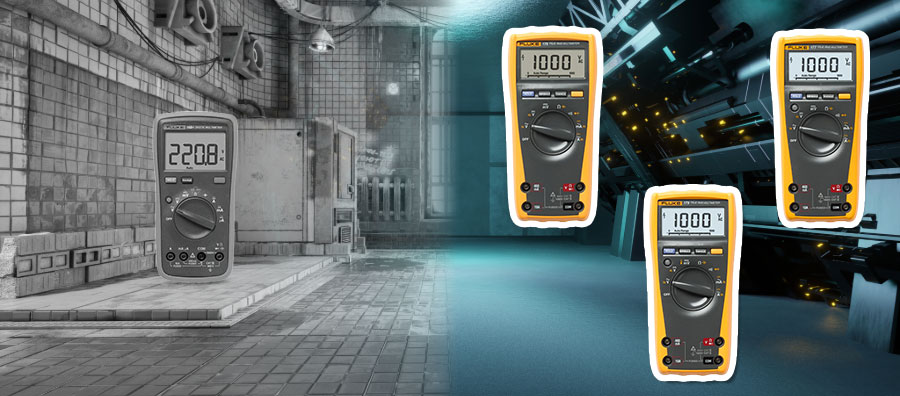
Entry-level digital multimeters are ideal for quick checks, but they can become limiting once you start working on live systems, motor drives, HVAC equipment, control panels, or sensitive electronics. You may notice inconsistent readings, lower safety margins, or slower troubleshooting, and that’s usually the point where a basic meter becomes a bottleneck rather than a tool. So what comes next? How do you futureproof your next purchase? Read on to find out more…
Signs You Have Outgrown Your Digital Multimeter
If your meter struggles with fluctuating signals, lacks the right safety rating, or feels fragile in daily use, it is probably time for an upgrade. That is especially true if you test switchboards, fixed installations, industrial equipment, HVAC systems, or electronic controls.
Many professionals – be they electricians, industrial maintenance technicians or HVAC engineers – could benefit from an upgrade that will help improve workflow, reduce risk, and increase confidence in every measurement taken.
Trusted by experts, the Fluke 170 Series (the Fluke 175, 177 and 179) represents a proven step up from entry-level meters and might just be the answer.
What Makes the Fluke 170 Series Different?
The Fluke 170 Series is designed for real troubleshooting, not just occasional testing. All three models cover the core functions most professionals need:
- AC/DC voltage
- AC/DC current
- Resistance
- Continuity
- Capacitance
- Frequency
- Duty cycle
The Fluke 179 also adds temperature measurement, which is useful for HVAC and industrial diagnostics.
Unlike many other multimeters, they are also True RMS, so they read distorted AC signals more accurately than basic meters. They also share a 6000-count display and analogue bar graph for ease of use, plus manual and auto-ranging, Min/Max/Average functions, and strong safety ratings of CAT III 1000V / CAT IV 600V.
And that’s exactly where the Fluke 170 Series has established itself as the benchmark – delivering a balance of accuracy, safety, and durability that professionals rely on every day.
The Three Models at a Glance
|
Model |
Best For |
Key Features |
|
General troubleshooting |
True-RMS, 6000-count resolution |
|
|
Electronics and precision work |
Higher accuracy, backlight |
|
|
Industrial diagnostics |
Temperature measurement, full feature set |
In simple terms, the Fluke 175 is ideal for everyday fault finding - hitting the sweet spot between capability, usability and price - whilst the 177 takes things further by adding better DC accuracy and a backlight, offering additional precision where needed. This leaves the 179 as the most advanced model, boasting additional features such as temperature measurement for broader diagnostic work.
Why True-RMS, Accuracy and Resolution Matter
True-RMS and 6000-count resolution are not just spec-sheet terms, they help you get more reliable readings on modern electrical systems and spot smaller voltage drops or unstable behaviour that entry-level meters can miss.
This matters because many modern loads distort the waveform; a basic meter may misread those signals, while a True-RMS meter like the Fluke 175, 177 or 179 gives you a more dependable result and helps avoid wasted time chasing the wrong fault.
Multimeter Safety Ratings Explained
Electrical measurement isn’t just about accuracy, it’s about safety under real-world conditions, and that’s where CAT ratings come into play.
- CAT I: Suitable for low-energy electronics and protected circuits
- CAT II: Plug-in equipment and appliances
- CAT III: Distribution circuits, such as consumer units and fixed installations
- CAT IV: Utility connections, service entrances, and outdoor lines
The Fluke 170 Series carries a CAT III 1000V / CAT IV 600V rating, which makes it better suited to serious electrical work and measurements closer to the power source, as it has been proven to perform under stress.
Fluke 175 vs 177 vs 179: Which One is Right for You?
- If you need a dependable professional meter for general troubleshooting, installation checks, and routine testing, consider the Fluke 175
- Choose the Fluke 177 if you need more accuracy for electronics, control systems, or lower-light environments where a backlight might be useful.
- If you want the broadest capability, especially for industrial work, HVAC, or applications where temperature measurement adds value, the Fluke 179 is probably the sensible choice.
Summary
If you want the best upgrade from an entry-level multimeter, the Fluke 170 Series is easy to justify, offering True-RMS measurement, strong safety ratings, reliable accuracy, and practical features that make troubleshooting faster and more dependable.
If your current multimeter is becoming the weak link in your toolkit, upgrading to a Fluke 170 Series meter is a worthwhile investment.