
Before adding electric vehicle chargers, heating, catering equipment, or other significant new loads to a site, one question needs a measured answer: how much spare capacity is actually available on the incoming supply?
It’s a common issue in upgrade projects; a site may have operated without obvious electrical problems for years, but that doesn’t automatically mean it has enough verified headroom for additional demand. That uncertainty can lead to costly assumptions, sometimes prompting unnecessary supply upgrade discussion, or unnecessary risk by allowing projects to proceed without a clear view of available capacity.
A project at Dalhousie Castle Hotel and Spa (recently shared by Chauvin Arnoux) serves as a useful example of how power logging can help answer that question properly, with the site needing to establish whether its incoming supply could support a substantial heating upgrade without requiring further intervention. To do that, electrical specialist Alan Chan carried out a week-long logging exercise using four Chauvin Arnoux PEL113 Power and Energy Loggers.
Why verifying spare capacity matters
When new electrical loads are being planned, installed load alone does not tell the full story. What matters is the relationship between the site’s actual demand and the capacity available on the incoming supply. That is especially important on occupied commercial sites, where disruption can carry real operational and financial consequences. Hotels, leisure facilities, commercial kitchens, managed buildings, and mixed-use properties often have variable demand profiles, which means a one-off measurement or rough estimate may not be enough to support a sound decision.
Where the goal is to assess whether an existing supply can accommodate further load, logging demand over time is often the more reliable approach.
Assessing the site and the challenge
Dalhousie Castle Hotel and Spa, located south of Edinburgh, operates from a 13th-century property with 35 en-suite bedrooms and five function or conference rooms. The planned upgrade involved the installation of electric radiators and heated towel rails throughout the property, along with provision for a new commercial kitchen.
The incoming supply was fused at 400 A per phase and had been in service without issue for years. The difficulty was not a known electrical fault, but a lack of measured demand data. Without a clear picture of actual current consumption, there was no reliable way to determine how much of the available supply capacity was already being used.
The proposed additional load was significant:
- 35 bedroom electric radiators at 1.5 kW each
- 35 heated towel rails at 500 W each
- 5 further radiators for conference and function rooms at 1.5 kW each
- a new commercial kitchen
Taken together, that represented an additional connected load of approximately 86.5 kW. Before committing to the work, the site needed evidence that the existing supply had enough headroom to support it.
Why power logging was the right method
In this type of application, the value of a power logger is straightforward - allowing engineers and contractors to assess real demand on a live installation over a representative period, rather than relying on assumptions or isolated spot checks.
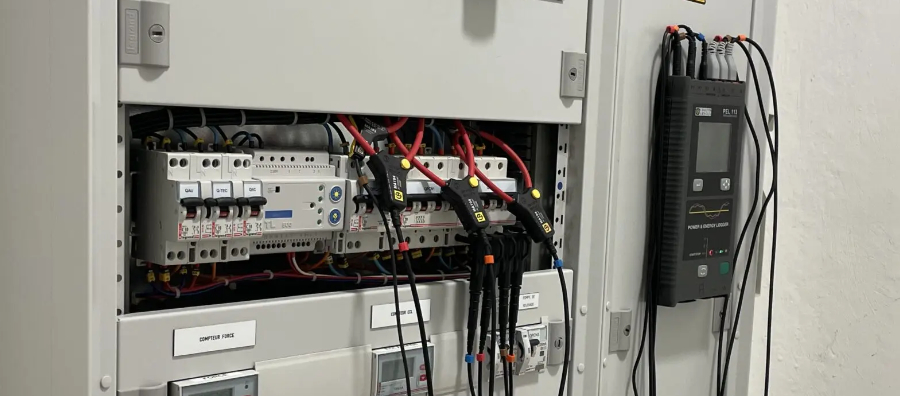
For this project, four Chauvin Arnoux PEL113 Power and Energy Loggers were deployed across the site. As the requirement was to log current only, no voltage connections were needed, so flexible current sensors were looped around the meter tails, with one logger fitted at the main incoming supply and three installed at downstream consumer units.
That setup offered two clear advantages; first, it allowed the assessment to be carried out with minimal disruption to the site; second, it produced recorded data that could be used to support a practical engineering decision, rather than relying on assumption or over-cautious guesswork.
What the data showed
The loggers remained in place for a full week before being retrieved and downloaded into PEL Transfer software. Using five-minute aggregated readings from the main incoming supply, the recorded peak currents over the logging period were:
- 173 A on L1
- 142 A on L2
- 157 A on L3
Against an incoming supply rated at 400 A per phase, the maximum recorded demand remained comfortably below the fuse rating, giving Alan Chan the evidence needed to confirm that the site had sufficient headroom for the proposed upgrade.
The outcome
With a seven-day current log in place, it was possible to confirm that the heating upgrade could proceed without the need for a supply upgrade from the Distribution Network Operator. For the hotel, that meant avoiding potentially unnecessary cost and disruption. For the engineer involved, it meant being able to support the recommendation with measured site data rather than approximation.
This is where equipment such as the Chauvin Arnoux PEL range proves its practical value. In projects involving load expansion, supply assessment, or demand verification, the question is rarely whether more data is available in theory, but more whether the right data can be gathered in a way that supports a confident, evidence-based decision.
What professionals can take from this
This case is a good example of a wider principle; when additional electrical loads are being considered, spare capacity should be verified, not assumed. For engineers, contractors, and facilities professionals, a power logger can help with:
- checking maximum demand before adding new loads
- verifying available capacity on an incoming supply
- assessing demand over time rather than at a single moment
- supporting client recommendations with measured evidence
- avoiding unnecessary upgrade costs where the existing supply is already sufficient
This all matters because the best decisions are rarely based on installed load alone, they come from understanding how a site behaves in practice.
Explore Power Quality Analysis & Energy Logging
As this case study demonstrates, if you need to verify spare electrical capacity before adding new loads, the Chauvin Arnoux PEL range offers a practical way to measure demand, assess headroom, and support supply-side decisions with recorded data.
For more information on how Power Quality Analysers & Energy Loggers can upgrade your toolkit, or for guidance on selecting the right equipment for your needs, our expert team are on hand to help. Please contact us on 0113 248 9966 or email sales@test-meter.co.uk.