

Since the launch of Acoustic Imaging back in 2019, I’ve been on countless onsite demos and trials searching for leaks on compressed air & gas systems to vacuum leaks, tightness testing, partial discharge and motor failure.
During this time, more often than not, I've helped businesses enhance their conditioning monitoring, preventing downtime and saving them money by quickly locating compressed air leaks. On the other hand, I’ve also experienced wasted journeys and disappointed customers where the technology of “seeing sound” didn’t produce the results as expected.
Acoustic Imaging technology can be a surefire investment with a very quick ROI for many companies, but equally, it's not a one-size-fits-all solution. At times, expectations are set too high by product datasheets and sales jargon that tend to overpromise.
Before choosing an Acoustic Imager, it is imperative to consider the following points before making your choice:
- What are you looking for? What is your problem? What is the objective? Is it compressed gases, vacuum leaks, partial discharge, motor failure or something completely different? (Trust me, I’ve done some interesting demos)
- Features - Are you looking to quantify the costs of your leaks, both in money and your environmental impact? This may help narrow down the right product for you.
- Safety – Does the equipment need to be ATEX rated, or can you work with a hot permit?
- Budget – Prices range from £5k up to £22k.
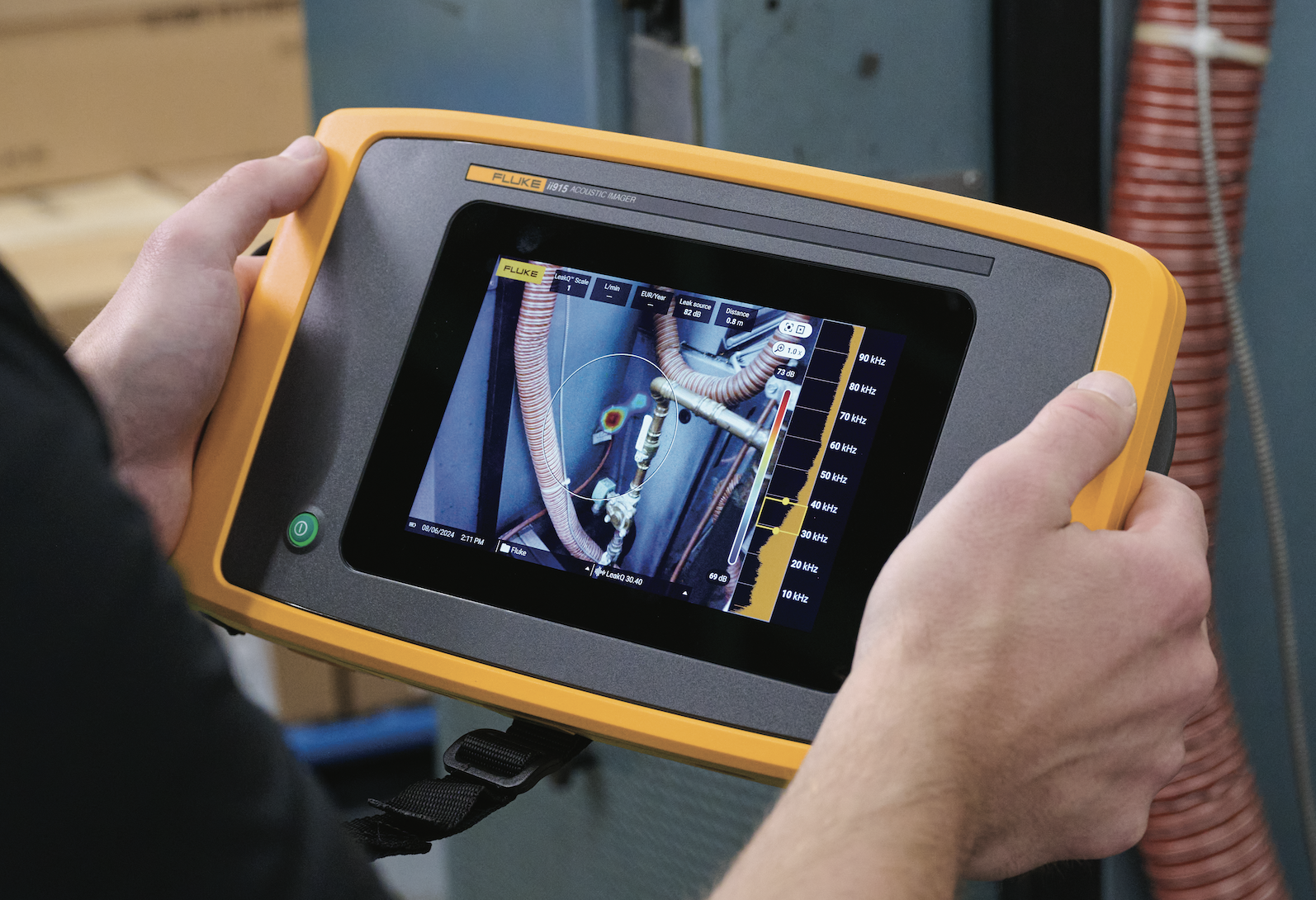
THE GREAT POTENTIAL – Cost savings, and can this technology help us reduce our Carbon Footprint?
‘I’ve just paid for an air leak survey, so I doubt you’ll find anything’
I love a challenge, and this was what I was told after a three-hour drive to a customer's premises. I put my PPE on and was taken to the factory floor, machinery was running, and you could hardly hear yourself think! A quick scan of the area I was standing in, and I found five leaks instantly. Within ten minutes, I’d found twenty leaks. The customer was amazed that they were found so easily in a working environment. The leak survey they had previously paid for was done during a two-week factory shutdown. All in all, I was with the customer for less than an hour, and the order was received the following week.
Acoustic Imagers are easy to operate
OK, you’re spending a lot of money on some kit, anywhere up to twenty-two grand! You need a return on investment! The last thing you want is for the kit to be locked away in a cupboard and not used, or you’re frightened to use it in case you use it incorrectly. That’s why whenever I quote to an end user, I always include onsite training as part of the package. Once done, your whole team will be confident in using the kit.
Acoustic Imaging technology is evolving all the time. Cameras are getting more sensitive, they have features to assist in your drive to net zero and can give you estimated costs of your leaks.
The most important question… Return on investment!
You’ve seen the posts and videos online. ‘Look at this leak we’ve found’ But what does it mean for your business requirements? Are you looking to cut unnecessary waste due to ever-increasing energy bills? Or are you looking to make CO2 savings as part of your drive towards Net Zero?
Herein lies (in my opinion) the most necessary (and often forgotten) part of Acoustic Imaging.
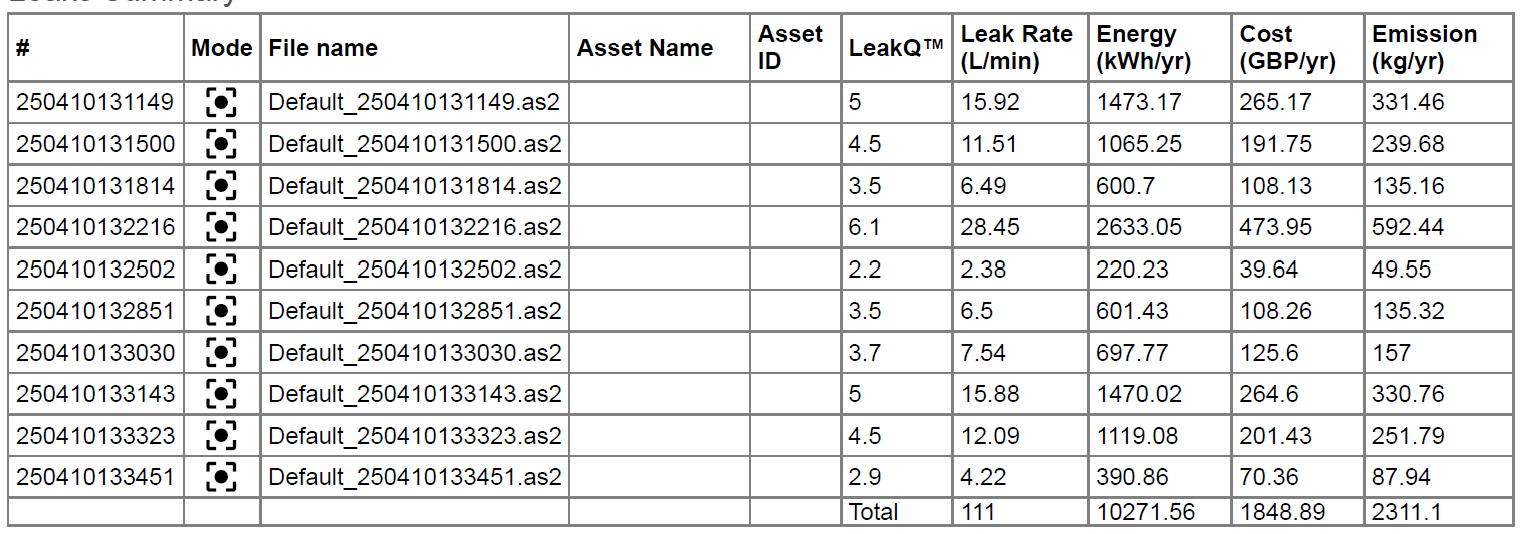
Reporting!
All leaks incur a cost, but what is it costing you? As you can see from the image shown above, this particular demo lasted 20 minutes on a small section of a factory floor. I found 10 leaks in a very short space of time. The potential savings? Nearly £2,000 a year and 2,300 kg a year in CO2 emissions.
From experience, on a £20,000 purchase, the cash return can be anywhere from a month to two years. The CO2 savings are immediate!
DEBUNKING THE MYTHS and general limitations
While on paper, many manufacturers claim to do all of the above and more, the reality is that the technology is still young and does have limitations as to what it can find. For example, equipment at the lower end of the price scale is not ATEX rated and cannot detect vacuum leaks. Higher-cost cameras are much more sensitive, meaning they have greater capabilities in the field.
Beware of what you see and read online!
I have seen a lot of talk on social media that the acoustic technology can detect x, y or z over the last twelve months. However, these are often done in perfect or simulated conditions, which is a far cry from the real world we all work in. I will reiterate the importance of an on-site demonstration at your site. I’ve had great success and catastrophic failures of what on paper is exactly the same demonstration, but in reality is not alike!
Can Acoustic Imaging find any compressed gas leak?
I put my head in my hands and shook my head in disbelief when I saw this claim! Not all gases have the same density. Lighter gases such as hydrogen and helium are difficult to find, whereas standard density gases such as compressed air and argon can be simpler to find. I know it sounds like I'm repeating myself, but make sure you have an on-site demonstration so you can check for specific gases as needed!
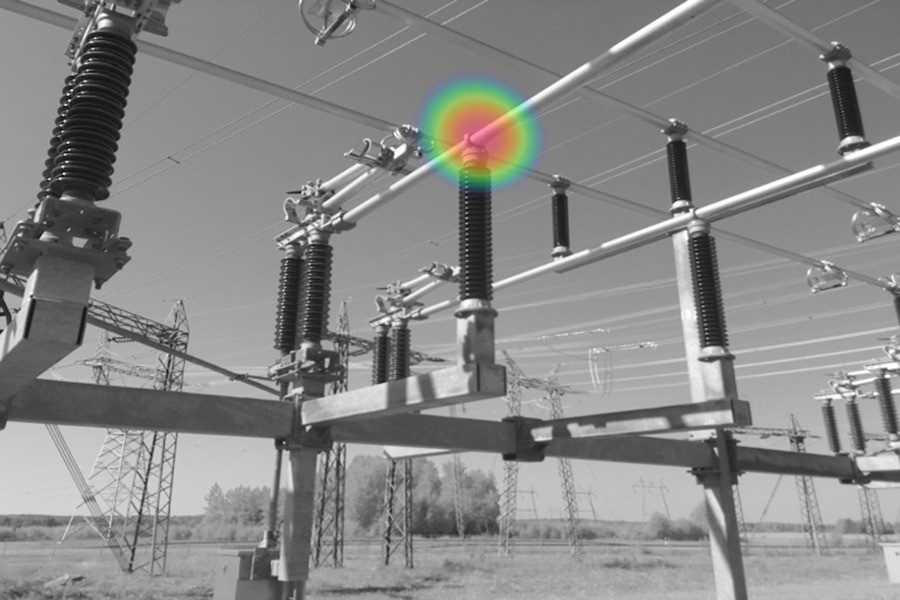
Should acoustic imaging be used in substations?
Hmm, the jury is out on this one. Yes, you can detect partial discharge using the higher-end “PD” models. However, would you trust it in comparison to your TEV? I wouldn’t, or at least not yet! I’ve found Corona Discharge no problem on overheads; however, inside your cabinets, the sound needs a way out of the casing for the Acoustic Imager to find it. There is no phase lock, so you can’t confirm 100% on what partial discharge you find. My advice (at least for the time being) is to continue using your current equipment.
As for claims that it can find SF6 leaks… Yes, it can find it if you create a leak from the charging bottles, but once it’s in the switchgear, it will not find where the leak is coming from. The only equipment available to see where it leaks from is Optical Gas Imaging Cameras.
Can you find vacuum leaks?
Yes you can, but it needs to be proven on a case-by-case basis. I’ve also had instances where they have not been found! My biggest nemesis is vac bag moulding, with negative pressures being so small, they are really difficult to detect. However, the rustling of the bags emits the same frequency as a leak! So, thirty people bagging up in a room creates too much background noise to be able to find a leak. If no one else is bagging up, then I found the leak. In the real world, it wasn’t suitable for their application.
Contact us for an onsite demo!
As previously stated, the most important thing I recommend is a demonstration at your premises and in situ. Never make a purchase without seeing it first! Remember, Acoustic Imaging isn’t for every application – it can also help in identifying some different applications and add further value that wasn’t considered!
We supply a range of Acoustic Imaging products from brands such as FLIR, Fluke, Megger, Hikmicro and more. We always offer a site demo or try-before-you-buy service to ensure that the product is right for the objective and is within budget. Get in contact now with any questions about Acoustic Imagers or to arrange a demonstration. Our advice is impartial and not biased towards one particular manufacturer, only the best solution.
0113 248 9966 (option 1 for Sales)
sales@test-meter.co.uk
andys@test-meter.co.uk

About the Author
Andy Street is a Key Account Manager at Test Meter Group with a knack for nurturing strong client partnerships through expert insight and service. A dedicated family man and self-taught foodie, Andy brings the same passion to his kitchen as he does to supporting his customers.